AC Kershaw's latest Crime Fiction Series -The Mancunian Tales
Showing posts with label Reviews. Show all posts

Tuesday, 4 July 2017

Great Ghost Stories on Children's TV in the 80's


The one thing I loved as a child was ghost stories. The first time I heard War of the Worlds at school I went home, nicked my brother's tape recorder, locked myself in the bedroom in the dark and created my own haunted house story complete with creepy sound effects. Fast forward a couple of years and I was excited to get home from school to watch The Children of Green Knowe. 
It was a guilty secret because I was in high school at this point, but I was still a kid, right?


In a boarding school somewhere in post-war Britain, Toseland (Alec Christie) or, as he preferred to be known as Tolly receives word from his Father that he will be spending Christmas with his maternal Great Grandmother known as Mrs Oldknow (Daphne Oxenford). Tolly's festive home will be the ancient Oldknow family home of Green Knowe. Within the confines of Green Knowe, Mrs Oldknow regales Tolly with the stories of years past. Tolly plays hide-and-seek with ghostly children who perished in the Great Plague and it turns out these children are dead rellies somehow (Not sure because a whole generation seemingly was wiped out, but hey, I was 13 so I didn't ask such questions back then. 


The spooky kids were Toby (Graham McGrath), Alexander (James Trevelyan) and Linnet (Polly Maberly). It's not all fun and games, though, as the ancient tree-spirit Green Noah is intent on getting his branches on Tolly.
Again not sure why and there was something to do with St Christopher the saint of travellers walking through a stream in the dark! To be fair I do need to watch this series again and lucky for me it's on You Tube! 


Based on the Green Knowe series of books by Lucy M Boston, The Children of Green Knowe was dramatised by John Stadelman for BBC1 in 1986. 
The Children of Green Knowe is in the same vein as other BBC telefantasies The Box of Delights and The Chronicles of Narnia, so you know what to expect - well spoken children, a bit of magic, some horror and a wonderful soundtrack. 

 The BBC always do a great job with period dramas and The Children of Green Knowe is no exception. It conjures up a show which is watchable, cosy and just perfect for a quick spot of festive viewing. 


Moondial is a childrens ghost/fantasy drama made by the BBC and transmitted in 1988.The story is about a young girl, Minty (Siri Neal), who is staying with her aunt after her mother is injured in a car accident. Minty spends much of her time wandering around the grounds of a nearby mansion, and is drawn to a moondial that enables her to travel back in time, where she becomes involved with two children, Tom (Tony Sands), who lives in the Victorian era, and Sarah (Helena Avellano), who seems to live further back in time.


Jacqueline Pearce, who played Servelan in Blakes 7, plays the dual role of the vicious Miss Vole (who seems to have lived in the 18th Century) and the present-day ghost hunter Miss Raven. And she still creeps me out. She plays great characters. I also loved this series because the thought of being able to wonder around a huge mansion whilst being completely invisible to the other people (except the children) appealed to my weirdness.

My Fantasy Sci-fi Books on Amazon/Kindle

My Writing and Books Website


RentaGhost


“If your mansion house needs haunting just call Rentaghost,
We’ve got spooks, and ghouls, and freaks, and fools, at Rentaghost,
Hear the Phantom of the Opera, sing a haunting melody,

Remember what you see, is not a mystery, but Rentaghost.”


Rentaghost was a British children's television comedy show, broadcast by the BBC between 6 January 1976 and 6 November 1984. The show's plot centred on the antics of a number of ghosts who worked for a firm called Rentaghost, which rented out the spirits for various tasks. The company, located in South Ealing, is run by Fred Mumford, a recently deceased loser who feels he can find work for ghosts whose lives were as unsuccessful as his. 
I loved this series and even pretended my bedroom was haunted, drawing lots of ghosts like the rentaghost below and sticking them around my room. I then told a girl on my street my room was haunted and when she saw the paper ghost, she ran away screaming!!!

His first (and only) recruits are Timothy Claypole, a mischievous jester with a comical lack of knowledge about modern technology; and Hubert Davenport, a delicate Victorian-era gentleman who is morally shocked by the modern world. The ghosts work from an office, which they rent from Harold Meaker, who discovers the truth about them in the third episode. Over the course of several series, other characters were added: Hazel the McWitch, a Scottish witch; Nadia Popov, a Dutch ghost who suffers from hay fever and teleports away when she sneezes; and the pantomime horse Dobbin, and is brought to life by Claypole.


When actor Michael Darbyshire(who played the role of Davenport) died in 1979, Anthony Jackson (Mumford) declined to appear in the next series, leaving Michael Staniforth's Claypole the sole original ghost; Davenport and Mumford's absences were explained at the start of the series by the pair having gone on an extended tour of stately home hauntings. After Mumford's departure, the business was taken over by Harold Meaker and his wife Ethel, who suffered from the various problems the ghosts brought to their lives.


The long-suffering neighbours of Rentaghost are the Perkins, who appear from Series 4 onwards, and think the Meakers are mad. I do actually remember the original series and cast, even though I was very young back then. Just goes to show how fascinated I was with the supernatural even at a very young age.


Wednesday, 28 June 2017

Children's Sci-fi and Fantasy TV of the 1980's

Aliens in the Family TV Theme Tune

Premise - David (Rob Edwards) and Phillipa (Clare Clifford), are a newly married couple, both having children from previous relationships. David is bringing Jacqueline aka Jake (Sophie Bold) to his new home to Phillipa and her daughter Dora (Claire Wilkie) and son Lewis (Sebastian Knapp) Jake, is very tomboy like in nature is the polar opposite of Dora who's into her fashion and appearance.

Meanwhile, up in that there galactic galaxy, is a Galgonquan spaceship where - another set of siblings - Bond (Grant Thatcher) and Solita (Elizabeth Watkins) are getting all anxious about Bond's upcoming assessment. Solita needs to disguise herself on Earth as an everyday object and Bond is tasked with locating and retrieving this (all after disguising himself as a human being man). 


Doesn't sound too testing, but there's also the threat of the sinister Wirdegen to contend with who want to do nasty things to Galgonquans.
Things go wrong for everyone. Jake can't stand life at David and Phillipa's house and Bond finds himself fleeing from the Wirdegen almost as soon as he's set foot on Earth. Bond ends up with the Earth kids on a desperate quest to find Solita and get home.

Bond finds Solita in an old transistor radio and must reach the stone circle before the Wirdegens catch them. They slip through time, and it's implied that Dora and Bond are related as they both posses the same family heirloom stone. What is fantastic is that the series is now on You Tube!
I loved this series because I fancied the pants of Grant Thatcher and I had this sneaky wish to be an Alien. Think it may have something to do with being all seeing and all knowing.

The Wirdegen were a great addition and the menace portrayed by the Wirdegen leader was simultaneously fantastic and nightmare inducing. (He was also a Deatheater in Harry Potter films!
And it turned out the Wirdegen's were just Galgonquan in disguise, testing Bond. The filming location was generally in Devon, spotting the Exeter bus station, stone circles on Dartmoor and the time slip scenes at Becky Falls.


Another Alien Series - that I absolutely loved was the sci-fi drama series of the 80's I remember watching was the 1984 adaptation of John Wyndham’s Chocky. This was Wyndham’s final science fiction novel published in 1968 and set slightly in the future, where as the Children's TV version was contemporary. I have watched the 3 series on YouTube (Chocky's Children and Chocky's Challenge. 

The premise of both the novel and the series is that Matthew, a 12-year-old boy, suddenly appears to have an imaginary friend named Chocky. His parents become worried about his behaviour and eventually Chocky reveals herself as this ball of glowing light. She's here on a mission to understand Earth and uses Matthew as a vessel to understand the world.
The interest of the story is that it’s a kind of science fictional twist on the demonic possession idea, but the real twist is that Chocky really appears to be rather benign. Perhaps even benevolent. Having your son possessed by an alien entity, even an apparently benevolent one, is still rather disturbing. Although as a child watching this I just thought it was great to have a secret friend who made you super clever! We all used to talk about it at school the next day.
In Chocky's Children Matthew goes on holiday and meets a mathematical prodigy Albertine (after Einstein of course) who is unaware of Chocky, but the alien tutors her and makes her uber clever. The precocious child hates Matthew's suggestion that she is clever through alien intervention until she is kidnapped by a group who want to find out Chocky's secrets. 

The third series, I don't think I watched, or only watched part of it as it wasn't that memorable... Chocky's Challenge, (I was probably too old to watch kids TV by then), but I have watched it since and think it was... not very good. Basically, they had to build something that would save the world and create cosmic energy, but if trapped inside would kill them! The series threw up more questions and most of it was spent with Chocky's Children silently talking to each other telepathically and smiling or giggling at one another because they'd figured something really intelligent out. The acting was really wooden too. Big thumbs down.


Tuesday, 20 June 2017

Great Old Sci-Fi TV that Inspired My Imagination

Sapphire and Steel

This had to be one of the creepiest TV series I remember. Even back then I liked scary stories and science fiction. The programme centres on a pair of inter-dimensional operatives, Sapphire and Steel. Very little is revealed about their purposes or backgrounds in the course of the series, but they appear to be engaged in guarding the continuing flow of time. They are two of several elements that assume human form and are sent to investigate strange events; others include Lead, who takes the aspect of a jovial, friendly giant, and Silver, a technician who can melt metals in his hands, there is also Jet and Copper.


Sapphire's special powers is to manipulate time in small ways as well as determine the age or historical details of an object by touching it. Her most prominent ability is to "take back time," literally rewinding it in a localised area to see or replay the past. Steel can freeze himself to absolute zero which gives him the ability to destroy 'ghosts', which are remnants of Time. 
Theme Tune Intro


He possesses immense strength  and is telekinetic, freezing people with a look or unbolting or welding metal objects.

The scariest series I thought was assignment four where the man with no face controlled people in photographs and all the children were dressed as Victorian children, but when Sapphire touched them they turned to paper. The worst bit was the shop keeper setting fire to a photograph with a woman in the window of the building screaming. Horrible, but as a child I found fascinating and glued to the box.


Space 1999

The series is set in the year 1999. The crew on moon base Alpha are sent hurtling in Space when a nuclear waste storage unit explodes, knocking the Moon out of orbit and sending it, as well as the 311 inhabitants of Moonbase Alpha, hurtling uncontrollably into space. The runaway Moon, in effect, becomes the "spacecraft" on which the protagonists travel, searching for a new home. Not long after leaving Earth's solar system, the wandering Moon passes through a black hole and later through a couple of "space warps" which push it even further out into the universe. 

During their interstellar journey, the Alphans encounter an array of alien civilisations, dystopian societies, and mind-bending phenomena previously unseen by humanity. Several episodes of the first series hinted that the Moon's journey was influenced  by a "mysterious unknown force", which was guiding the Alphans toward an ultimate destiny.
I loved this series so much and used to pretend I was on the spaceship and was some kind of alien like Maya, with special shape shifting powers.
Theme Tune and Episode


Blakes Seven

The TV show is set in the third century and at least 700 years in the future. Blake's 7's premise concerns the exploits of political dissident Roj Blake, who commands a small group of rebels against the forces of the totalitarian Terran Federation that rules the Earth and many colonised planets. The Federation uses mass surveillance, brainwashing and drug pacification to control its citizens. 


Blake is arrested and tried on false charges then deported to a remote penal colony. En route he and fellow prisoners Jenna Stannis and Kerr Avon gain control of a technologically advanced alien spacecraft. It's central computer, Zen informs them the ship is called the Liberator. 

Theme Tune and Episode


Liberator's speed and weaponry are superior to Federation craft, and it also has a teleportation system that enables transport to the surface of planets. Blake and his crew begin a campaign to damage the Federation, but are pursued by Space Commander Travis – a Federation soldier – and Servalan, the Supreme Commander who used to seriously scare me. Secretly I fancied Avon and used to play Blake's 7 on my local park many times. 


The Tomorrow People


The premise was about the emergence of the next stage of human evolution (Homo novis) known colloquially as Tomorrow People. Born to human parents, an apparently normal child experience a process called "breaking out" during adolescence and develop special paranormal abilities. These abilities include powers such as telepathy, telekinesis, and teleportation. However, their psychological make-up prevents them from intentionally killing others.

Weirdly I don't remember much about this programme, but I do remember the Theme Tune and it still gives me goose bumps today. It also gives me a sense a nostalgia for the old house I was born and brought up in.

My Sci-Fi Fantasy Books
Alison's Website

Thursday, 28 January 2016

Egyptian History Continues to inspire the Best Supernatural Books

The Abu Simbel Temple is actually two individual temples, both rock cut structures, and both built during the reign of King Ramses II sometime in the 1200 B.C. time period. One temple is dedicated to King Ramses II, and the second temple is dedicated to his beloved wife Queen Nefertari. She was his first and principal wife, and he cherished her above all other. Many ancient Egypt temples were built because of devotion in this fashion. We also had to cross the desert at four in the morning in coach convoy, to avoid hijackers just to see this amazing structure. The desert was eerily quiet, no birds singing. Not a peep! The carvings and artwork that decorate both structures of the Abu Simbel Temple are incredible. Hand carved pillars, wall paintings, carvings, statues, and much more delight anyone who sees them. This artwork is thousands of years old, and very delicate. In 1964 the two structures of Abu Simbel Temple were cut into many different pieces, and both temples were moved further away from the rising water of Lake Nasser. The structures were moved to a location sixty five meters above the original spot, and two hundred meters further back from the shoreline.
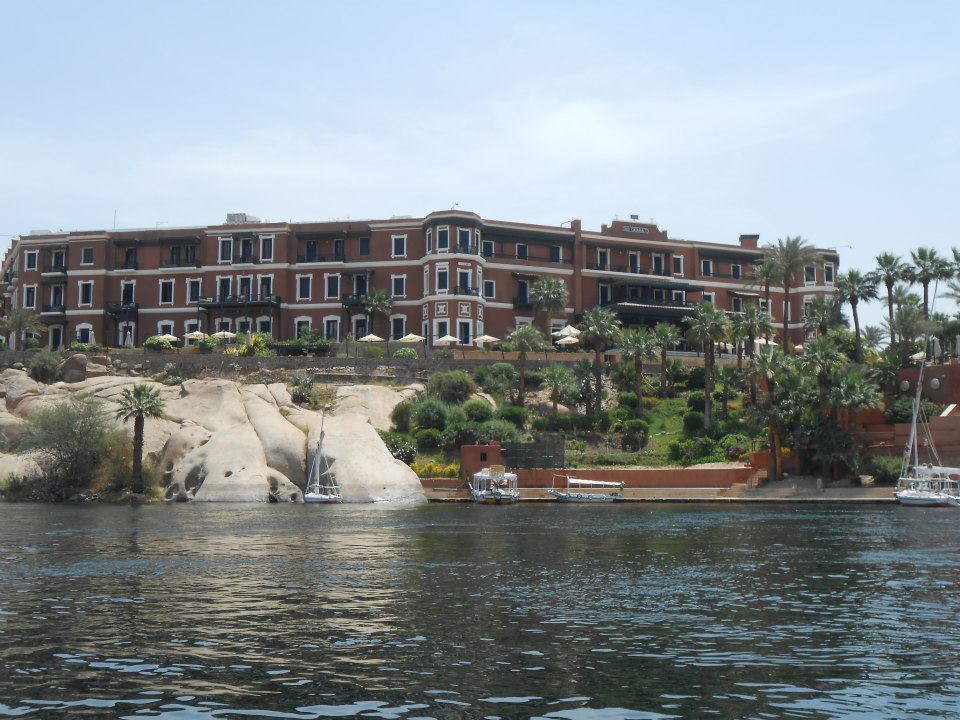
The Sofitel Legend Old Cataract Hotel, also known as the Old Cataract Hotel, is a historic British colonial-era 5-star luxury resort hotel located on the banks of the River Nile in Aswan, Egypt. It was built by Thomas Cook. Its guests have included Tsar Nicholas II, Winston Churchill, Howard Carter, Margaret Thatcher, Jimmy Carter, Princess Diana, Queen Noor and Agatha Christie, who set portions of her novel Death On The Nile at the hotel. The 1978 film of the novel was shot at the hotel, one of my favourite films.


Dam is an embankment dam built across the Nile at Aswan, Egypt between 1898 and 1902. The High Dam was constructed between 1960 and 1970, and has had a significant effect on the economy and culture of Egypt.to control floods, provide water for irrigation, and generate hydro-electricity were seen as pivotal to Egypt's industrialization

Before the dams were built, the Nile flooded every year during late summer, when water flowed down the valley from its East African drainage basin. These floods brought high water and natural nutrients and minerals that annually enriched the fertile soil along the flood plain and delta; this had made the Nile valley ideal for farming since ancient times. Because floods vary, in high-water years the whole crop might be wiped out, while in low-water years widespread drought and famine occasionally occurred. As Egypt's population grew and conditions changed, both a desire and ability developed to control the floods, and thus both protect and support farmland and the economically important cotton crop. With the reservoir storage provided by the Aswan dams, the floods could be lessened and the water stored for later release.

Our Captain navigating the cruise boat through the Nile.


On the Falooka's little children row up to the boats and sing songs for a few pennies from the tourists in the boats. The trip to Elephant Island, so called because the huge stones look like elephants. We also had a peaceful sail through the reeds around the Nile gave up a wonderful scene of local birds and wildlife. We drifted past the edge of the sahara desert with my feeling trailing in the Niles very cool and refreshing water. Apparently dangling your feet over the side of a Falooka boat with your feet in the water is supposed to bring you good luck and a healthy and happy life. So that's good to know.
Nubian House -The Nubians are a non-Arab Muslim population who lived in the geographical region known as Nubia in southern Egypt and northern Sudan. One hundred and twenty thousand Nubians were relocated beginning in 1964 because their villages were inundated by the Aswan High Dam Lake. Some argue that the name Nubians derives from a word in the Nubian language meaning slaves, but others say that the ancient Egyptian word nab meant gold and that the Ancient Egyptians used that term to refer to the Nubian Valley because of the gold mines nearby. 

The Temple of Edfu is an ancient Egyptian temple located on the west bank of the Nile in the city of Edfu which was known in Greco-Roman times as Apollonopolis Magna, after the chief god Horus-Apollo. It is one of the best preserved temples in Egypt. The temple, dedicated to the falcon god Horus, was built in the Ptolemaic period between 237 and 57 BC. The inscriptions on its walls provide important information on language, myth and religion during the Greco-Roman period in ancient Egypt.

Egyptian Market at Luxor takes up several streets near the Luxor temple. It is a joy to walk through, as it is mostly pedestrian and is a welcome respite from the horse and carriages on the main streets. This market really feels like an old souk and the visitor is taken back in time. It is covered with a wooden trellis, shading people from the sun. Many of the shops offer the same items, so the wise buyer shops around and looks for the best price. One can often bargain better after going to several stores.


Elephantine Island and beyond the Edge of the Sahara Desert.
Horse and carriage ride up to Edfu was frightening, having to ride through the city and be harassed by street sellers whilst trapped in the huge traffic jams.The temple of Edfu is the largest temple dedicated to Horus and Hathor of Dendera, Goddess of the sky, dance, love, beauty, joy, motherhood, foreign lands, mining, music and fertility. It was the centre of several festivals sacred to Horus. Each year, Hathor travelled south from her temple at Dendera to visit Horus at Edfu the event marked their sacred marriage was the occasion of a great festival and pilgrimage.

The bright colours of a gift shops can draw you in and once you find a merchant you like, sit down, have some tea, and begin the game of bargaining. It can feel like you are becoming a part of the family. Buying something as simple as a cotton galabeya can take several hours, as you try on almost every single galabeya in the store, and then move on to items that they think you may want as gifts for friends and family, but sometimes the bartering can become tiresome and annoying.


Isis Temple at Aswan.
Another example of a Nubian House near Aswan
Outside of how a Nubian house looks. Most of the houses have no roofs  except for the odd area behind the security walls, like the sleeping areas , which have some shelter from the rare occasion there is rain, but when walking around there is a distinct feeling of sleeping and living in the open air with surrounding walls to keep predators and warring enemies.
Old 1930's boat used to film Death on the Nile by Agatha Christie. I loved that film more than all the other Agatha Christie adaptations of her novels and although we weren't able to go and look around this traditional paddle river boat, the interior of our modern Nile boat was decorated very much with the feel and style of the art deco 30's. Lovely.
Sahara Desert from the plane.The Sahara is the world’s largest hot desert and one of the harshest environments on the planet. It is third largest desert overall after Antarctica and the Arctic, which are cold deserts.At 3.6 million square miles (9.4 million square kilometers), the Sahara, which is Arabic for "The Great Desert," engulfs most of North Africa. The desert covers large sections of Algeria, Chad, Egypt, Libya, Mali, Mauritania, Morocco, Niger, Western Sahara, Sudan and Tunisia. In other words - ITS BIG!!!

Alison's Website:http://www.alisonkershaw.com/book_lycan_lamia.php

Saturday, 16 January 2016

More Egyptian History to Inspire The Beyond Series of Supernatural Novels

 the week tour of Egypt via a beautiful River boat decorated in an English 1930's Art Deco style was just the tip of the iceberg on this amazing trip down the Nile in 2013. I visited many of my favourite historical sites that I've read about since I was old enough to read. Medinet Habu is the Mortuary Temple of Rameses III situated on the West Bank of Luxor with relief's and carvings depicting the wars defeating the "Sea Peoples" and was the place of worship specifically for the sun god Amun Ra.
 Amun Ra is the ultimate god of the entire ancient Egyptian deity system. Ancient Egyptians considered him as the God of Kings and the King of gods. He is the oldest and most worshipped deity and this photo show Rameses III paying homage to the ultimate sun god and a Pharaoh was considered the Son of Ra and the creator of all life. Whilst other Egyptian deities came and went in popularity throughout the civilisations lifespan, but Amun-Ra was the constant "super god" that was always worshipped. You can see the two distinct feather plumes on his head.
On the opposite side of the temples main gates is a relief of Rameses paying homage to another major god - Horus.
was a sun god and the king of the gods. “The living Horus” was one of the Pharaohs titles and emphasized his right to rule Egypt like Horus ruled the gods. His emblem was the falcon and he was one of the five Osirian gods along with Osiris, Isis, Set and Nephthys. One of the most well known symbols associated with Egypt is the Eye of Horus, which symbolized power.

Rameses II at Karnack: The Karnak Temple Complex, commonly known as Karnak, comprises a vast mix of decayed temples, chapels, pylons, and other buildings. Building at the complex began during the reign of Senusret I in the Middle Kingdom and continued into the Ptolemaic period, although most of the extant buildings date from the New Kingdom. The area around Karnak was the ancient Egyptian Ipet-isut ("The Most Selected of Places") and the main place of worship of the eighteenth dynasty Theban Triad with the god Amun as its head. It is part of the monumental city of Thebes. The Karnak complex gives its name to the nearby, and partly surrounded, modern village of El-Karnak,
Colossi of Memnon Statues also known as Whistling Statues as they are known to sing, usually an hour or two after sunrise. They are two massive stone statues of Pharaoh Amenhotep III, who reigned during Dynasty XVIII. For the past 3400 years (since 1350 BC) they have stood in the necropolis at Thebes, west of the River Nile from the modern city of Luxor.


 The Sphinx on the road to Karnak: The familiar depiction of the sphinx of ancient Egyptian culture is a creature with the body of a lion and the head of a man. Historians interpret this mixed form as a symbolic joining of a lion's strength and dominance to a king's intelligence. Although the sphinx's heads down the Pharaohs roads to Karnak also have different animal heads to represent and pay homage to various deities. For instance a sphinx with a rams head is the depiction of the king of Gods Amun-Ra.
 Sacred Lake at Karnak is the largest of its kind and was dug by Tuthmosis III (1473-1458 BC). It measures 393 feet by 252 feet and is lined with stone wall and has stairways descending into the water. The lake was used by the priests for ritual washing and ritual navigation. It was also home to the sacred geese of Amun (the goose being another symbol of Amun) and was a symbol of the primeval waters from which life arose in the ancient Egyptian’s idea of creation. It was surrounded by storerooms and living quarters for the priests. There was also an aviary for aquatic birds.
Amenhotep's Red Granite Sacred Scarab beetle monument located close to the Scared Lake is a huge tourist attraction, especially for the singletons of this world. The belief is that you walk seven times anti clockwise around the beetle wishing for your soul mate and you will receive a marriage proposal. I was unmarried at the time and oddly was proposed to in the local cafe after leaving the tourist attraction. The cynical person I am decided the canny cafe owner knew this so asking any lady seeming to be alone would gain extra business. However, just weeks after this trip I was proposed to by my boyfriend who is now my loving husband. So maybe the myth and magic of the Ancient Egyptians does work sometimes.

 Our huge boat had to pass through the locks heading towards Aswan Dam these little rowing boats would dangerously attach themselves to the huge tourist boats (I can't call them ships because they just weren't big enough) and sail along the side whilst attempting to throw table cloths and other souvenirs to the tourists sunbathing on the pool decks. As we entered the locks these two nutters rowed in with our enormous barge. In the UK it would have turned into a governmental Health and Safety Publicity Circus.


Osiris, Geb and Nut: Osiris was the god of the dead and resurrection. He was the ruler of the Tu'at and people would appeal to him to care for their departed ancestors. Osiris was the king of the gods until his brother killed him. Ancient Egypt held the goddess Nut (Osiris's Mother) as one of the most loved goddesses. Known as the sky goddess, she held the title of “she who gives birth to the gods.” From birth to death, Nut played an important role in Egyptian mythology as the barrier between the order of creation and chaos. Geb was Osiris's father and the god and personification of the earth. He was unusual because he was a male earth deity, while most ancient cultures regarded the earth as female.
At the moment you may be wondering what this all has to do with my books, but over the next couple of blogs, all will become clear. My fourth book in Lycan Lamia in The Beyond Series also makes everything become clear with my characters epic journey through the supernatural world.
Alison's Website: www.thebeyondseries.com